

Kindles are Go!
Finally got the Kindle version of the book out and on the virtual Amazon shelves.
Quick links to the various Amazon store websites can be found here:
https://agiledataguides.com/information-product-canvas/#kindle
The Self Publishing process was harder than I imagined
When I decided to self-publish I did a bunch of research, reading online posts, listening to podcasts and of course chatting with my LLM friends etc.
Self publishing seemed to be a bit in the process, but it didn’t seem that hard.
In hindsight it was a lot more onerous than I expected.
If you are thinking about self publishing feel free to reach out, I am always happy to share the process I ended up using and the experiences I encountered on my journey (both good and bad), remember Sharing is Caring!
The Kindle process was harder than I imagined
My good friend Kat Greenbrook had already self published the digital version of her excellent book “The Data Storyteller’s Handbook” (you should grab a copy of it from here https://www.roguepenguin.co.nz/book)
Kat was kind enough to share with me the pitfalls of converting the paper book to the Kindle format, and while forewarned it was still a lot more effort and trial and error than I expected.
But today i’m not going to write about the drossy process of creating Kindle formats, I am going to talk about how I decided the price for the Kindle version would be $9.99.
The book was all about scratching an itch (and a little bit of vanity)
As part of the research into writing a book I talked to a few people who had done it.
The overarching feedback was that the writing process was onerous and you will make bugger all money.
Yes there are books that are constantly in the best seller ranks for many years, the Fundamentals of Data Engineering by Joe Reis and Matt Housley is an example of one of those books, it has been a best seller on Amazon in both print and Kindle versions for many years. To be constantly at that best seller level a large number of copies must have been sold.
While I have no idea how much of the sales price for an O’Reilly book goes to Amazon, (i’m guessing O’Reilly gets a discounted deal from Amazon given the volume they sell through it) and how much O’Reilly as the publisher gets vs Joe and Matt as the authors, i’m going to guess that they have done financially ok from that book. And good on them, great book at the right time.
But for most authors I talked to, who didn’t create a consistent best seller the royalties from their books were always a nice surprise, but they weren’t buying new cars with them (a shout out to those who were kind enough to share their numbers).
When I was lucky enough to chat with Joe Reis on his podcast about my experience with the book writing process (you can listen to it here : https://creators.spotify.com/pod/profile/joereis/episodes/Shane-Gibson---The-Power-of-the-Information-Product-Canvas-e36huq6 ) he asked me why I decided to write the book.
And my answer was it was something I had always wanted to do, it was an itch I wanted to scratch and I finally decided to spend a couple of years part time, scratching that itch.
While this is true what I didn’t say (or maybe I did) is there was also a large amount of vanity behind it. I have always wanted to be a published author, see my name on the cover of a book etc, and although its much more accessible to do this via self publishing these day’s and slightly less prestigious as a result, the vanity card was always on my table.
So now onto the dirty subject of money
When you publish a physical book via Amazon KDP there are a few decisions you have to make, that effect the cost of the book and how much you make from each sale.
The first is the size of the book, the physical dimensions and the number of pages.
The second is if it is black and while or colour.
The third is the type of cover, paper back, hardback etc.
Each of these are inputs into the final number Amazon KDP charges you each time they print the book for a customer.
After those choices you pick the retail price for the book.
Amazon KDP then charge you a percentage of that retail price as a royalty for them and the cost of printing and you get what is left.
So the calc is:
(Authors Royalty rate x list price) – printing costs = Authors Royalty Amount
(There is also a hidden little cost if you are not a US tax resident, where Amazon KDP also hold a % of the Authors Royalty Amount as IRS with holding tax that I cant see a way to get back).
So lets have look at an example for the paper back version of my book.
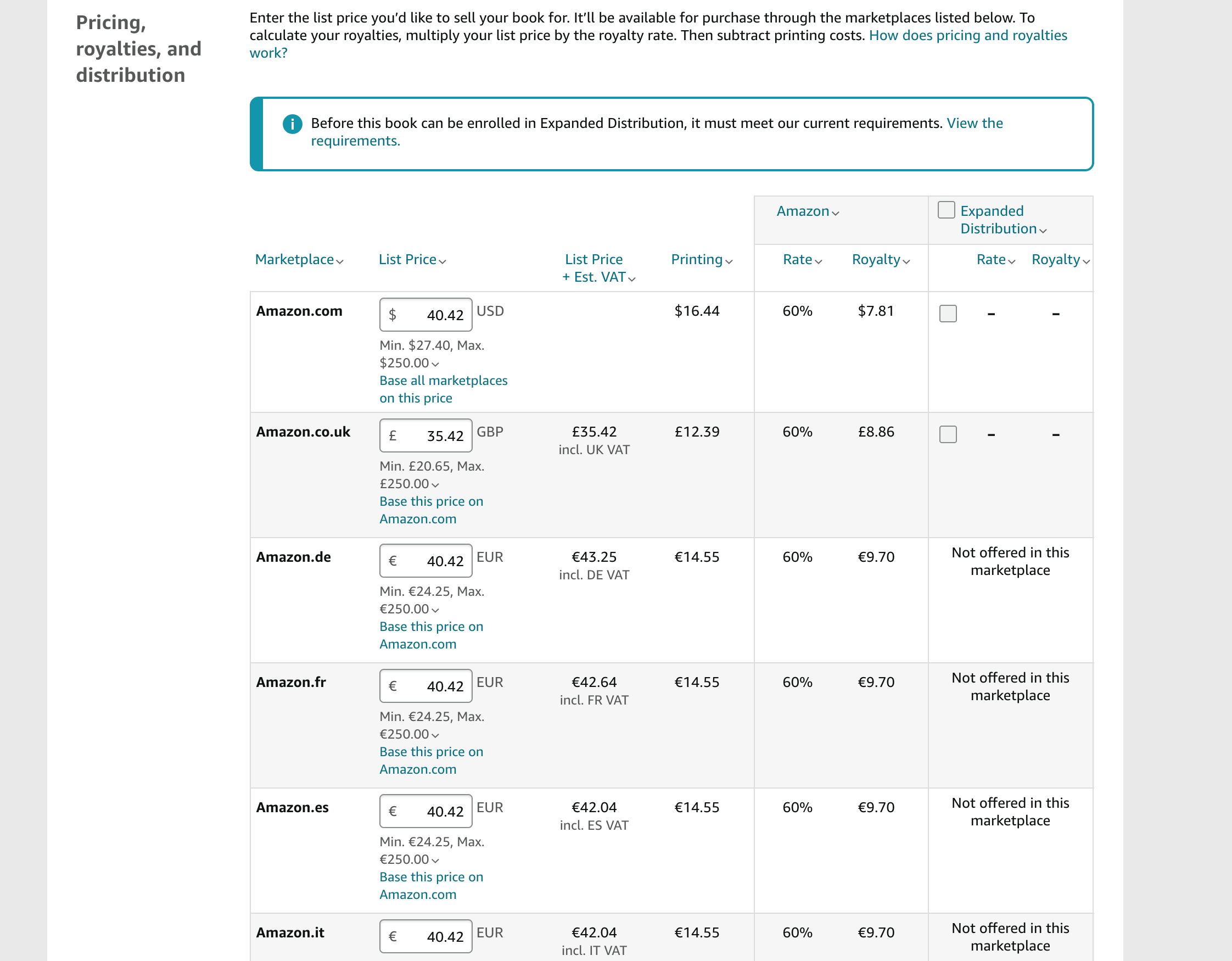
So you can see with a retail price of USD $40.42 on Amazon.com, Amazon KDP take:
40% of the retail price as royalties = USD $16.16
USD $16.44 for the printing costs
And I as the author get USD $7.81 from each sale.
A few things to note:
The dimensions of my book are custom and I went for the highest quality colour paper I could, and a gloss cover so that is at the higher level of print cost per page
You pay per page printed, my book is 193 pages so a fairly small page count compared to some of the other text heavy data books which would cost more to print
The US IRS withholding tax comes off my $7.81 before they send me the money
Amazon KDP hold the money for a couple of months before they send it to the author, I received my payment for July sales at the end of September.
The other trick for young players is you think (well I did) that the 60% of the retail prices is all yours, but actually the printing costs come out of your side of the equation.
So Amazon KDP get 40% of the retail price as their royalty, you get 60% minus the printing costs.
Now to be clear, the ability to self publish via Amazon KDP with their print on demand service seems to be a much better option compared to paying for a large run of books yourself and then also paying for them to be stored and shipped, not to mention dealing with the ordering and shipping logistics, payment processing and fees etc.
The other thing is a lot of authors make their money not from the books themselves but from the paid courses, consulting and speaking engagements that happen as a result of publishing a book.
So now onto the Kindle pricing
The way Amazon KDP manages the pricing of the Kindle version is of course different to the paper version as there are no physical printing costs.
The first thing is you need to decide if you want to take an Authors Royalty Rate of 35% or 70% for your Kindle version.
Easy you would always take the 70% right?
Well here is the rub, for the 70% rate you cannot charge more than $9.99 for the Kindle version and you have to pay a digital delivery fee based on the the size of the digital file for your book.
For the 35% option you can charge what you want for the Kindle version (well there is a bottom and top cap) and you don’t pay for the digital delivery fee.
You can read about the rules here:
https://kdp.amazon.com/en_US/help/topic/G200644210
Buts lets look at a couple of examples for my book.
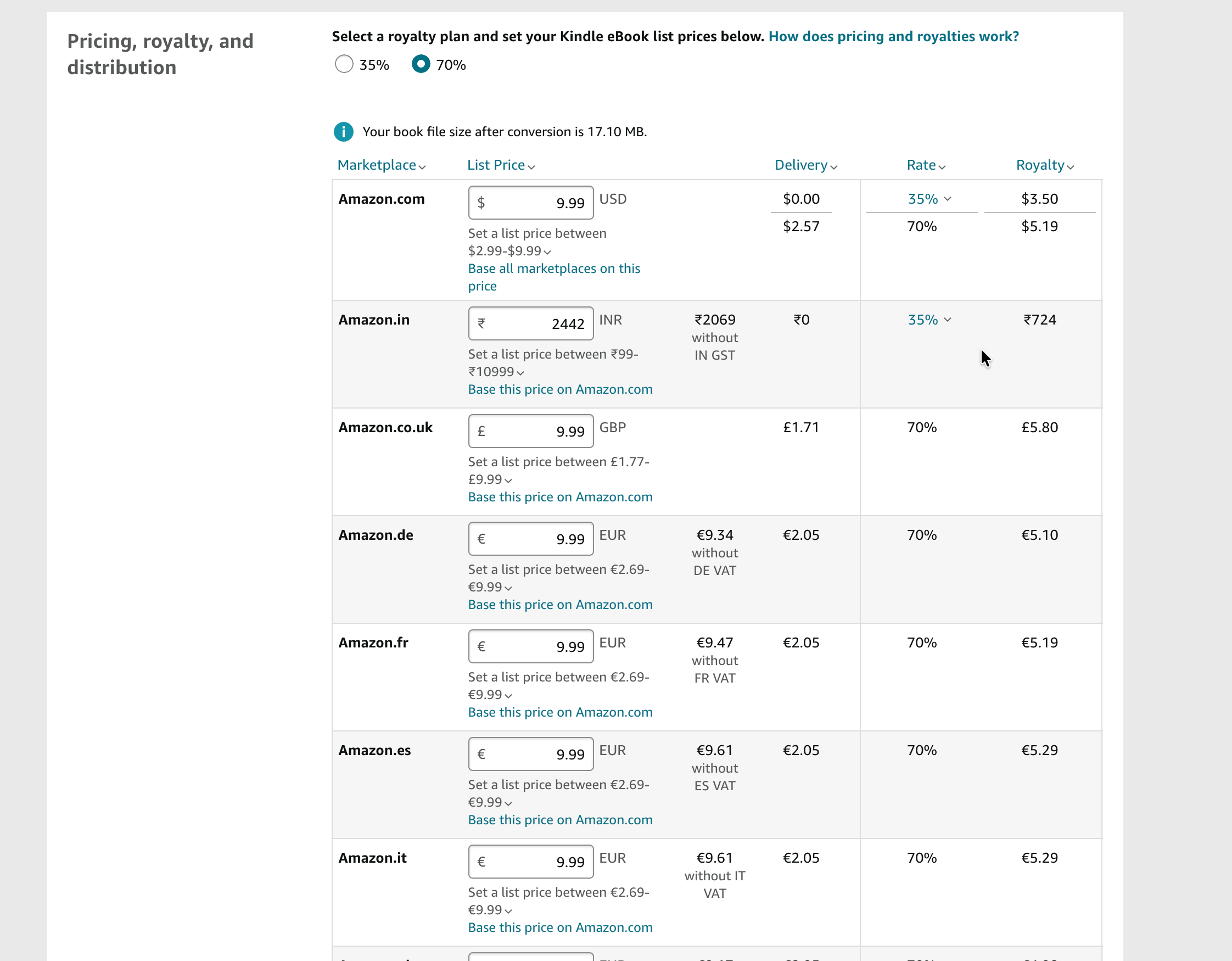
My Kindle version with the price set at $9.99
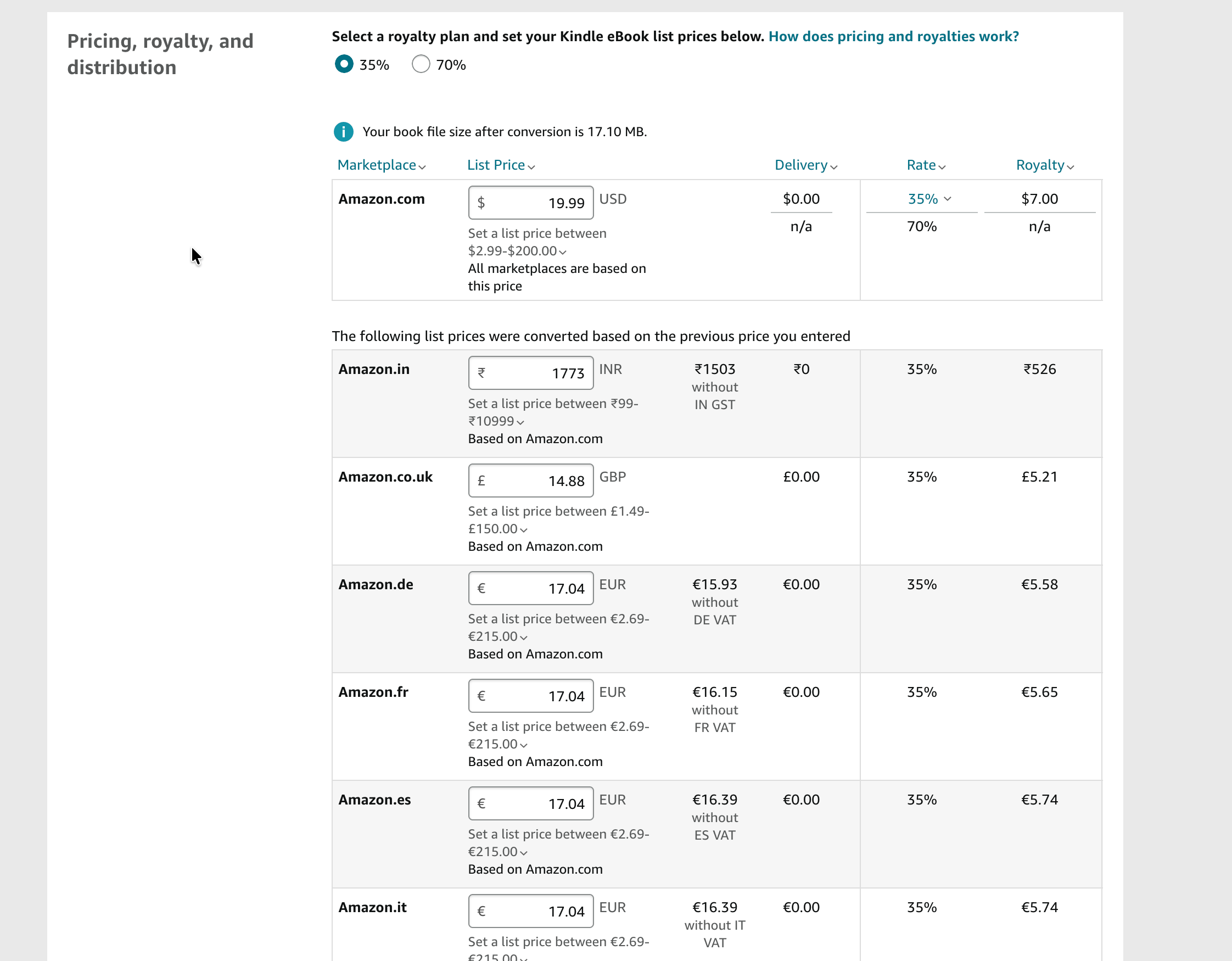
Then at $19.99
Then at the same price as the paper version $40.42
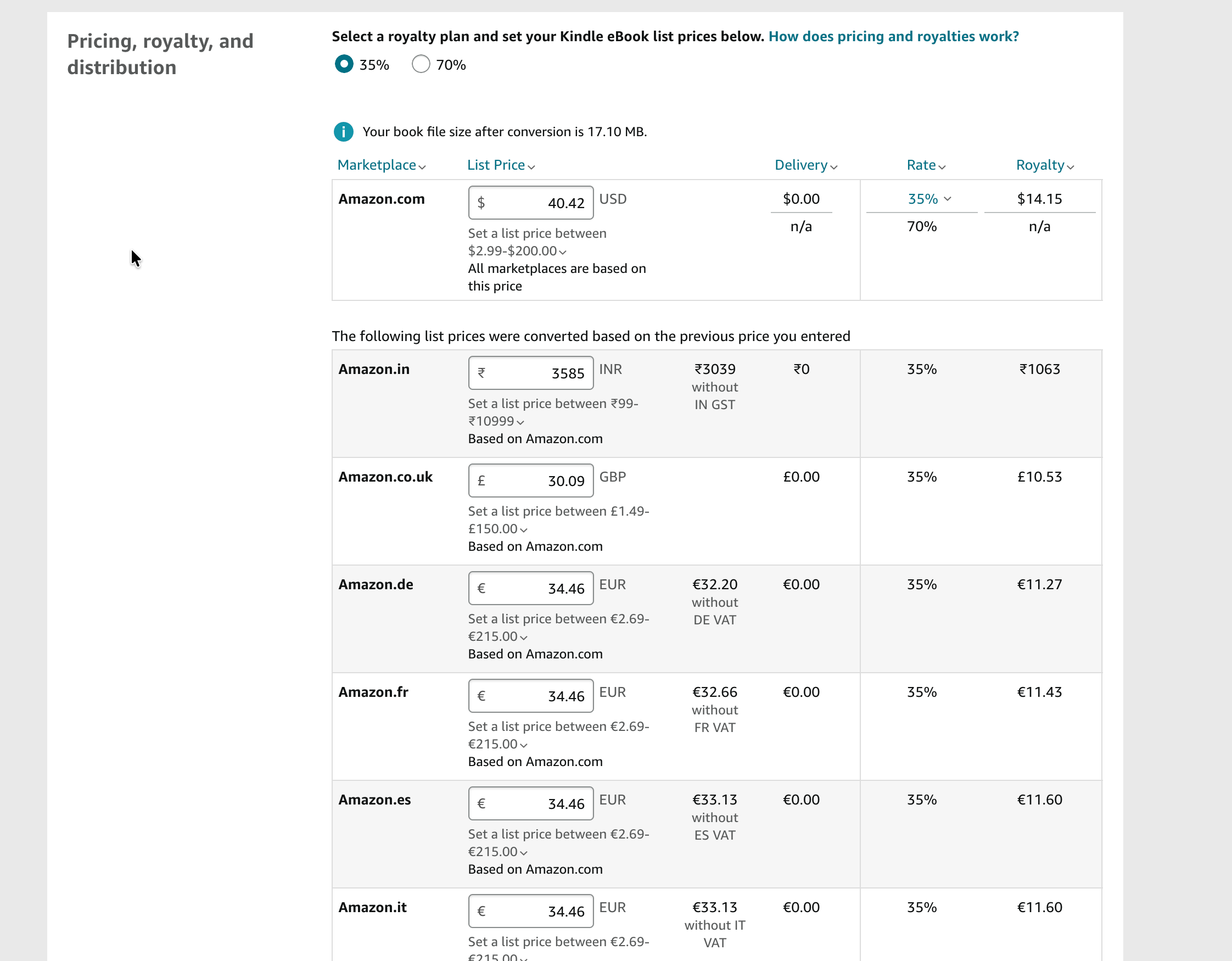
So a spread between $5.19 and $14.15 per Kindle sale.
And as you can see you can also change the price per region.
The devil is in the data
As you can imagine these options meant I jumped into data analyst mode trying to work out the optimal cost vs royalty return, with some parameters for likely uptake of sales based on the cost compared to the historic physical book sales.
Would $8.99 vs $9.99 make a difference to how much I earnt.
What was the ratio other authors and publishers used for print vs Kindle.
Why did O’Reilly always seem to price their Kindle version just below the print version.
And of course as my book is very image heavy I could also reduce the digital cost for the 70% option by reducing the quality of the images in the book.
In the famous words of one of our personal go-to Xmas movies
Enough, enough now!
Why did I write this book, it was to scratch an itch, not to get rich.
Yes its has decades of experience imbedded in it, but the majority of the book is available on this substack site entirely free.
Yes at $9.99 it might be seen as I am “undervaluing” it and people wont buy it because it seems to be too “cheap”
After training a myriad of Data and Analytics teams over the years on how to use the Information Product Canvas to improve the way they gather data requirements, I still get a buzz helping people change the way they work for the better.
With an Author Royalty Amount spread between $5.19 and $14.15 per Kindle sale, would an extra $9 per sale change my life? NO!
The final thought was would I spend $40 for a Kindle version of a book I wasn’t sure would be any value to me. NO!
Would I spend $9.99 to take a punt it might be useful. YES!
So with that the death by a thousand data decisions was gone and a quick decision made, $9.99 it was.
Grab a copy of the book for the price of two cups of coffee.
Grab the Kindle version if you want an digital version of the book.
Quick links to the various Amazon store websites can be found here:
https://agiledataguides.com/information-product-canvas/#kindle
A warning:
Because of its visual design, this is a FIXED LAYOUT Kindle eBook, it is only readable on some devices.
Or as I put in the Kindle version …..
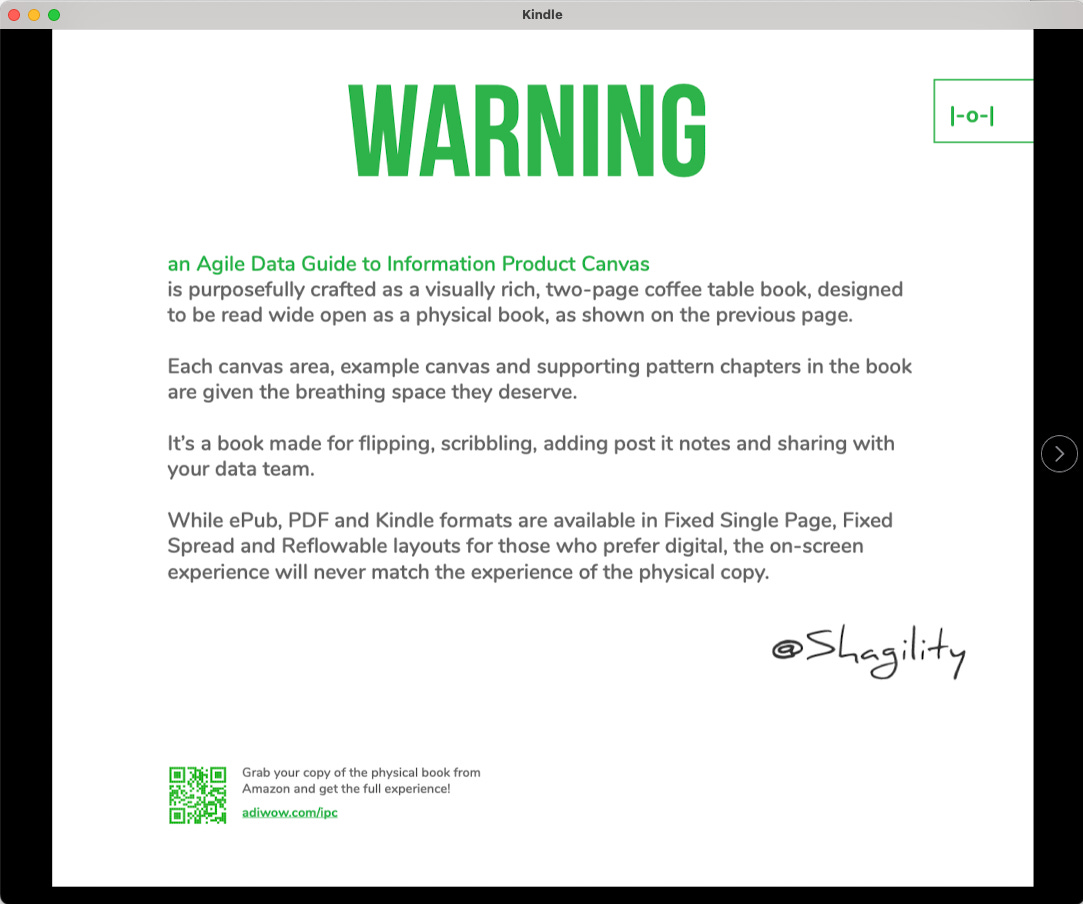
As I say the book really has been designed to be read as a physical book.
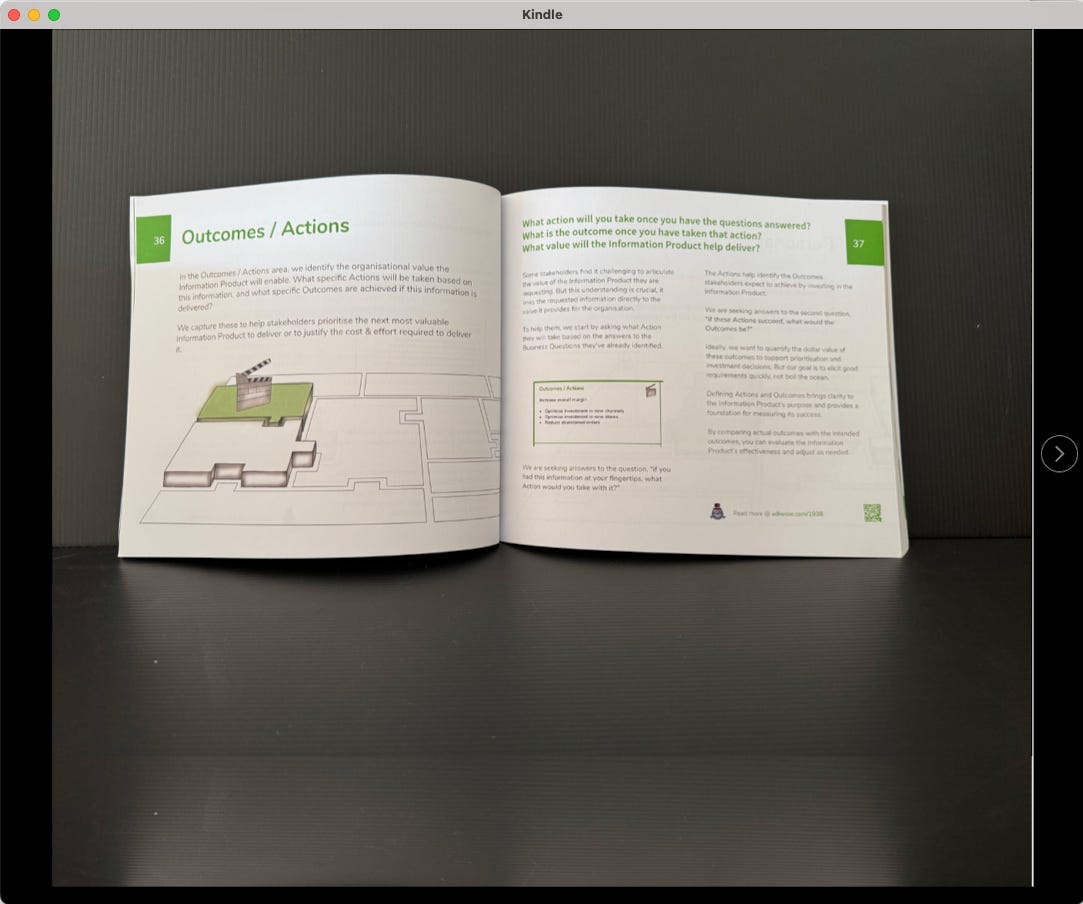
So while you can read it on a Kindle, and I get that for some of you Physical books are not your jam, the layout has been designed for this double page physical spread and I have made minimal compromises on that layout in the single page Kindle version.
What about those non Kindle users out there?
I still have creating an ePub and/or PDF version on my backlog list, which I will publish via my Shopify store.
Who knew creating eBook versions of a book would be such a faff !
So if you would prefer that over the Kindle version, flick me a reply email and Ill let you know when its Done Done.